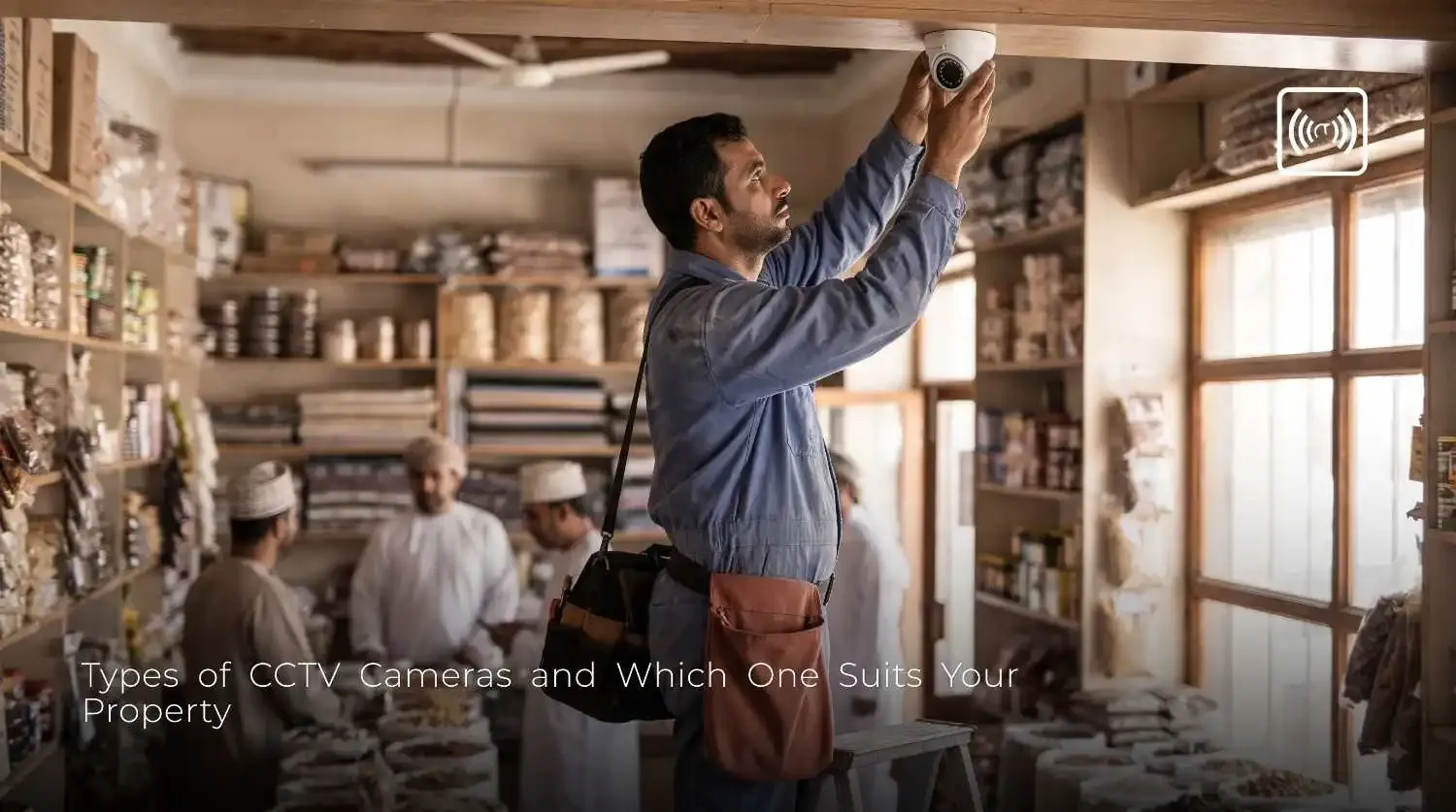
Types of CCTV Cameras and Which One Suits Your Property
Types of CCTV Cameras and Which One Suits Your Property
Walk into any security equipment shop in Muscat or Sohar and you will see dozens of cameras that look almost identical. Some are small and silver, some are round and dark, some sit on a motorised bracket and turn to follow movement. Most business owners we meet have one question before anything else: which of these do I actually need? The honest answer is that the right CCTV camera depends on where it is mounted, what you need to see, how long you need to keep footage, and how much light the area gets at night. This guide walks through the main types of CCTV, explains the technology behind them, and helps you work out which system fits your home, shop, office or site.
Why Understanding CCTV Types Matters Before You Buy
A camera that performs well in a parking lot can be useless in a narrow corridor. A dome camera that looks discreet in a hotel lobby may struggle to read a number plate at the gate. When a system is designed around the wrong camera, the usual result is blurry footage, blind spots and a recording system that fills up in a few days. Choosing the correct type from the start costs less than replacing cameras a year later.
Good CCTV design starts with a simple question: what do you want the camera to do? Watching for general activity, identifying faces at an entrance, reading vehicle number plates, and covering a large open yard are four different jobs. Each one points to a different camera type, lens and mounting position.
The Main Types of CCTV Cameras
Most CCTV cameras fall into a handful of physical designs. The housing determines where the camera can be installed, how well it resists weather and tampering, and how obvious it is to people walking past. The lens and sensor determine what it actually records.
Bullet Cameras
Bullet cameras get their name from their long cylindrical shape. They are easy to spot, and that visibility is often the point. A bullet camera on a wall near a gate or driveway tells visitors that the premises are monitored. Most bullet models come with built-in infrared LEDs for night viewing, and a weatherproof housing makes them suitable for outdoor use.
Bullet cameras are a good choice for perimeter walls, car parks, building exteriors and long corridors. Because the lens is exposed at the front, they are easy to aim at a specific view, such as a driveway or a shop entrance. Their weakness is that the lens can be targeted or obscured if it is mounted at a low height, so they should be placed out of easy reach.
Dome Cameras
Dome cameras sit inside a rounded transparent cover. The dome hides the direction the lens is pointing, which makes it harder for someone to tell whether they are being recorded and which area is covered. This is why dome cameras are common in shops, offices, banks, lobbies, lifts and hotel corridors. Many dome models are vandal-resistant, and indoor versions are discreet enough to blend into a ceiling.
The trade-off is that a dome camera's field of view can be limited by its lens angle and by the glare from the dome itself, so it needs careful positioning. Mounted on a high ceiling, a dome camera can cover a large room, but a person's face may only be visible if the camera is placed at the right height.
PTZ (Pan-Tilt-Zoom) Cameras
PTZ cameras can move sideways, up and down, and zoom in or out. An operator or an automatic tracking function can direct them to a specific point, which makes them useful for large areas such as factory yards, warehouses, parking lots, construction sites, and campuses. One PTZ camera can often replace several fixed cameras, but it does not watch everything at once. While it is pointing at one spot, the rest of the area is unrecorded unless another camera covers it.
PTZ cameras are more expensive than fixed cameras and need a stable power supply and a suitable recording system. They work best when someone monitors the feed or when preset patrol positions are configured carefully.
Box (Fixed) Cameras
Box cameras are the traditional rectangular cameras with a separate, interchangeable lens. They are not weatherproof on their own, so they are normally installed inside a housing. Their main advantage is flexibility. You can choose a lens with a narrow field of view to read number plates at a gate, or a wide-angle lens to cover a room. For projects where the exact lens matters, such as identifying faces at an entrance or reading plates at a barrier, box cameras give the most control.
360-Degree (Fisheye) Cameras
A 360-degree camera uses a fisheye lens and software to capture a full circular view from a single point, usually on a ceiling. A single unit can cover a shop floor, a small office, a reception area or a waiting room. The footage is circular and needs to be "dewarped" by software or by the recorder before it looks natural on screen.
These cameras save installation cost because they replace four or five conventional cameras in one room. The drawback is that image detail is lower at the edges of the circle, so faces near the outer rim may be hard to identify. A 360-degree camera is ideal for overview coverage rather than detailed identification.
Number Plate Recognition (ANPR) Cameras
Automatic Number Plate Recognition cameras are specialised. They use a high-resolution sensor, a narrow lens, a fast shutter speed and often infrared illumination to capture a vehicle's registration plate clearly, even when the vehicle is moving. Gated communities, factories, schools, apartment complexes and commercial parking areas use them to log vehicle entry and exit, and some systems link the plate data to access control.
For ANPR to work, the camera must be mounted at the right angle, usually facing the approaching traffic, and the lighting must be consistent. A poorly placed ANPR camera produces plates that are too small, too angled or washed out by headlights, so these systems need a proper site survey before installation.
Thermal Cameras
Thermal cameras detect heat instead of visible light. They are useful in complete darkness, through smoke or light fog, and in areas where people or vehicles need to be detected early, such as remote perimeters, plantations, and agricultural properties. Thermal cameras show the presence of a warm object rather than identifying who it is, so they are usually combined with a visible-light camera for full coverage.
Analog, HD and IP: Understanding the Technology
Physical shape is only half of the decision. The signal technology behind a camera decides its image quality, cabling, cost and how easily the system can grow.
Analog and HD-over-Coax Cameras
Traditional analog cameras send video through coaxial cable to a DVR. Newer HD-over-coax formats, such as HD-TVI, AHD and CVI, use the same type of cable but deliver higher resolution, commonly 2 MP or 5 MP. These systems are reliable, cost-effective and easy to upgrade in existing buildings because the wiring can often stay in place. They are a sensible choice for small shops, homes and renovation projects.
IP Cameras
IP cameras are digital cameras that connect to a network through an Ethernet cable or Wi-Fi. They process video inside the camera, which allows higher resolutions such as 4 MP, 8 MP and beyond, along with features like smart motion detection, face detection, people counting and remote viewing from a phone. IP systems use a network video recorder (NVR) and a switch, and they are the right choice for larger sites, multi-branch businesses and any project that may expand later.
The main requirement for IP cameras is a properly designed network. A good switch with adequate power over Ethernet, correctly planned bandwidth and enough storage will keep the system stable. Poor network planning is the most common cause of IP camera problems we see on sites that were set up without a survey.
DVR or NVR: Choosing the Recording Unit
A digital video recorder (DVR) works with analog and HD-over-coax cameras. It converts the signal and records it onto hard drives. A network video recorder (NVR) works with IP cameras and receives the digital stream over the network. Both store footage, allow playback and can be accessed remotely, but an NVR is generally better suited to high-resolution, multi-camera and expandable systems.
When sizing a recorder, think about the number of channels you need now and in the future, the resolution and frame rate of each camera, and how many days of footage you must keep. A camera running at high resolution and constant recording uses a great deal of storage. A reasonable design leaves room for growth and uses a dedicated surveillance-grade hard drive rather than a standard desktop disk.
Key Features to Compare Before You Buy
Once you have narrowed the camera type, compare these features before choosing a model.
Resolution
Resolution decides how much detail you can see. A 2 MP camera is adequate for general overview. Identifying a face at a distance or reading a plate needs more pixels on the target, which means a higher resolution camera and a narrower lens. Resolution alone is not enough, because the lens and placement matter just as much.
Low-Light and Night Performance
Many incidents happen at night, so check how a camera performs in low light. Look for built-in infrared range (for example, 30 metres or more for outdoor bullet cameras), and for features such as starlight or colour night modes. Infrared works well in pitch darkness, but overly strong illumination on a nearby wall can wash out the image, so placement still matters.
Wide Dynamic Range (WDR)
Wide dynamic range helps when a bright source, such as sunlight through a shop door or car headlights at a gate, sits within the same frame as a darker area. Without WDR, the bright area is overexposed and the person standing in front of it becomes a silhouette. WDR is especially useful at entrances.
Weather and Vandal Protection
Look for an IP66 or IP67 rating for outdoor cameras, which indicates protection against dust and water. For areas where people may tamper with equipment, choose vandal-resistant housings and mount cameras out of easy reach. In Oman, heat, fine dust, sand and coastal humidity make corrosion-resistant housings and good sealing a practical choice.
Storage and Retention
Decide how many days of footage you need, and design the storage to match. Motion-triggered recording can reduce storage needs, but it should be tested to make sure important movement is not missed.
Which CCTV System Suits You? Matching Cameras to Use Cases
Here is how the camera types usually match common properties. Treat these as starting points, because every site has its own lighting, layout and risk profile.
Homes and Villas
Most homes need a small number of cameras covering the main gate, the front door, the driveway and the back entrance. Bullet cameras outdoors and a few indoor dome cameras are usually enough. A compact NVR or DVR with mobile viewing gives the household a live view from anywhere. A discreet setup with sensible placement is more useful than many cameras with poor coverage.
Shops, Restaurants and Showrooms
Retail spaces need a combination of cameras. Dome cameras cover the shop floor and checkout counter, a wide-angle or 360-degree camera can cover a small area, and a bullet camera at the entrance records faces and customer traffic. WDR is important at glass doors, and cameras should be positioned to capture the cash counter clearly. Many shop owners also value a live view from the mobile phone when they are away from the premises.
Offices and Commercial Buildings
Offices benefit from dome cameras in corridors, lobbies, lift areas and server rooms, plus box or bullet cameras at entrances. An IP system with an NVR is a good fit for offices that expect to add cameras, integrate access control or want to manage footage centrally across several floors or branches.
Warehouses, Factories and Yards
Large sites need coverage of wide areas. PTZ cameras watch yards and loading zones, fixed cameras cover gates and stock areas, and ANPR cameras record vehicles entering and leaving. Thermal cameras can add perimeter protection at night. Reliable power, weatherproof housings and enough recording capacity are essential, because downtime or missing footage can be costly.
Schools, Hospitals and Institutions
Institutions need clear rules about where cameras are placed and how footage is accessed. Entrances, corridors, parking and common areas are typical priorities, while private spaces such as washrooms and changing rooms must never be monitored. A well-documented IP system with role-based access to recordings works well in these environments.
Parking and Gated Communities
Parking areas and gated communities benefit from a mix of ANPR cameras at entry and exit points, fixed cameras for pedestrian gates and PTZ cameras to cover larger open lots. Clear vehicle logs help residents and management resolve disputes quickly.
Common CCTV Mistakes to Avoid
Experience across many installations shows the same mistakes again and again. Placing cameras too high makes faces unrecognisable. Pointing a camera directly at a light source or the sun creates glare that ruins the image. Choosing cheap storage that cannot handle continuous recording leads to missing footage. Skipping a site survey means the system may look good in a showroom but fail in the actual location. Finally, leaving default passwords unchanged and not updating camera firmware exposes the system to unauthorised access, especially when it is connected to the internet.
A short professional site survey before installation avoids nearly all of these problems. It also lets you confirm how many cameras you truly need and where the blind spots are.
Why Choose Concept Technologies LLC for Your CCTV System
Concept Technologies LLC works with homes, shops, offices, schools, factories and institutions across Oman. Our approach is to design the system around your actual site, not around a single product. That includes CCTV cameras of every type described above, DVR and NVR recording, alarm systems, access control, networking and fibre connections, and telephone or EPBX systems where needed. The goal is one reliable partner for all your security requirements.
Our team studies the site, explains the options in plain language, recommends the camera mix that fits your budget and risk, and then handles installation, configuration and handover. We show you how to view live footage and retrieve recordings so the system is useful from the first day.
Frequently Asked Questions
Which CCTV camera is best for outdoor use?
A weatherproof bullet or PTZ camera with an IP66 or higher rating and built-in infrared is the usual choice. Mounting height, angle and lighting determine how useful the camera is in practice.
Is an IP camera better than an analog camera?
IP cameras offer higher resolution and smart analytics and scale well. Analog and HD-over-coax systems are cost-effective and suit smaller sites or upgrades where existing cabling can be reused. The better choice depends on your size, budget and future plans.
How many days of footage should I store?
Many businesses keep 30 days or more, while homes often keep two to four weeks. The right number depends on your risk, local requirements and how much storage you plan for.
Can I view my cameras on my phone?
Most modern DVR and NVR systems support remote viewing through a mobile app, provided the network and internet connection are configured securely.
How do I get a quote?
Contact our team through the enquiry form on this website or send us a WhatsApp message with a short description of your property and what you want to protect. Our sales team will follow up, and where needed, arrange a site visit before recommending a system.
Get a CCTV Recommendation Based on Your Property
Every building is different, and the right camera mix is easier to choose when a professional has seen the site. If you are planning a new CCTV system or thinking about upgrading an old one, share your requirements with the Concept Technologies LLC team. We will help you choose the camera types, recording system and placement that match your needs, and we will explain every recommendation before you commit.
Related Posts


Latest Projects


Recent Posts